

our story


Before moving to Italy, I was deeply involved in a vibrant community print studio in Melbourne, where I managed and taught classes at the Firestation Print Studio while also working there as a studio member myself. It was an inspiring environment where artists from many different backgrounds worked side by side, sharing techniques, ideas and encouragement.
Printmaking, more than many other disciplines, naturally lends itself to this kind of shared space — where presses, processes and problem-solving are often collective. That sense of creative exchange — the conversations, the exchange of opinions, and the quiet companionship of people working together — is something I valued deeply and missed after relocating to rural Italy.

Before ...
When my printing press needed a new home, I mentioned the dilemma in passing to my friend Emma, who lives in the nearby hilltop village of Panicale. Without hesitation, she offered the cantina beneath her beautifully restored 17th-century villa.
At the time, it was very much a storage space — but it had good bones and a quiet sense of character. Standing there, surrounded by old stone walls and years of accumulated odds and ends, I began to imagine that it could become something more — a small studio where printmaking could once again be shared with others.

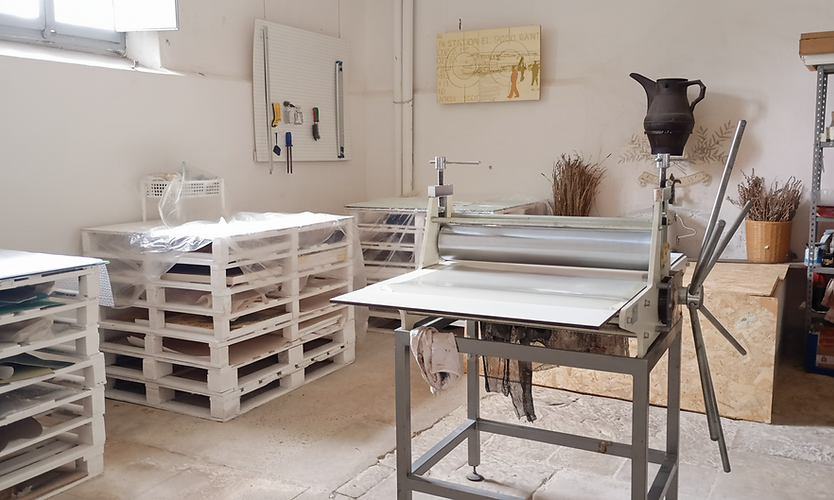
As the space slowly began to take shape, I started gathering materials locally to build the studio. Two sturdy tables sourced from a nearby village school now serve as the paper cutting and wetting stations, while the inking stations are constructed from stacked and painted pallets from a neighbouring apple farm — raised to an ergonomic height for comfortable working.
The inking surfaces themselves combine practicality and functionality: two are finished with smooth glass salvaged from a former gelato display case! While a third features a full inking top — all chosen for their durability, flexibility, and suitability for a variety of printmaking processes that allow up to 6 to 7 people to ink up simultaneously. The structure of the pallets also provide ample, much needed storage space.
While the studio has been assembled using available materials, it is set up to support non-toxic printmaking methods. All etching is performed outside. The studio will continue to evolve over time, with thoughtful additions that support the working process while maintaining the simplicity and character of the space. Processes such as spray aquatint allow for the creation of tonal work without the need for more hazardous traditional equipment, and the mordant used is one of the most environmentally responsible options available — safe, effective, and easily neutralised.
Much of the process takes place outdoors, where fresh air and natural light become part of the working rhythm. The result is a studio that balances resourcefulness with intention — a space designed not only for making, but for working safely, comfortably, and with a strong awareness of both materials and environment.
After ...
Around that time I met Julian Hyzler of Easels & Lens, who has been running painting retreats in Tuscany for many years. When he heard about the studio and my desire to return to teaching printmaking, he generously offered to help me get started. Our first retreats were collaborative, bringing together small groups of artists to explore both painting and printmaking while sharing in the atmosphere of the villa and its surroundings.
From those beginnings, the retreats gradually evolved into what is now Ink & Paper Italy — intimate printmaking retreats centred on both traditional and contemporary techniques, with a strong focus on non-toxic processes and creative exchange.
At the heart of it is a genuine love of printmaking itself — not only the process, but the moment when something unexpected happens on the plate, and the quiet excitement of seeing an image come to life. Sharing that experience with others, in a setting that encourages both focus and ease, has become an essential part of what these retreats offer.
Alongside time in the studio, there is also space to experience the rhythm of this part of Italy — the landscape, the light, the villages, the delicious Italian cuisine, and the slower pace of daily life — all of which naturally find their way into the work.